


Liaison office of Grand Ayatullah Sayyid Ali Al Sistani (L.M.H.L) in London, Europe, North and South America.
- Activities
- 9 Rajab 1447
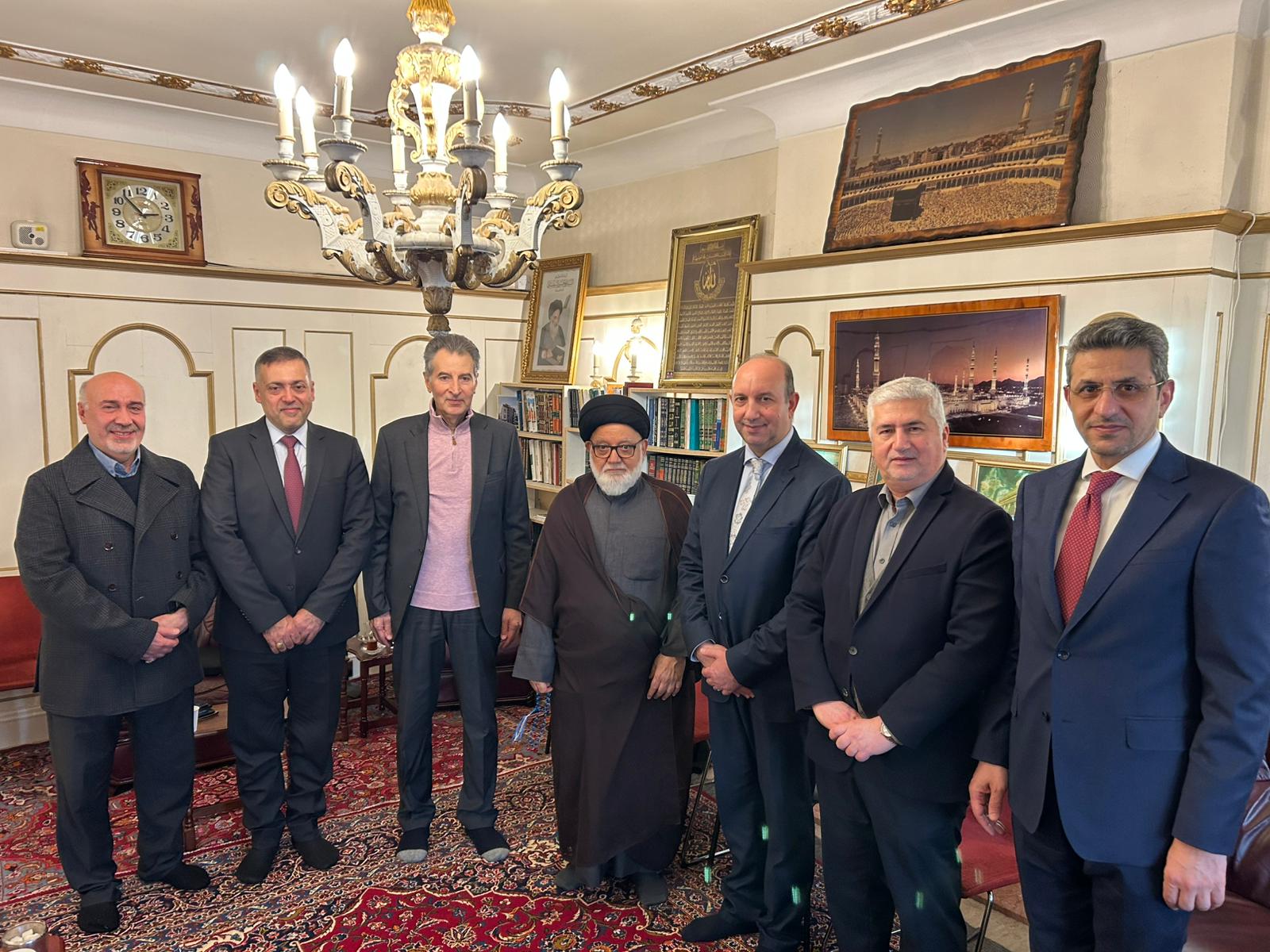
Imam Ali Foundation Receives Iraqi Ambassadors
A group of newly appointed Iraqi ambassadors, selected to assume diplomatic
posts in several world capitals, were received by the esteemed Sayyid
Murtadha al-Kashmiri at the Imam Ali Foundation in London. He warmly
welcomed them and addressed them with remarks inspired by the words of the
Commander of the Faithful, Imam Ali ibn Abi Talib (peace be upon him),
stating: “We are pleased to meet with you as you take on the honor of
representing Iraq on the global stage, in a position that delicately
balances politics and ethics, interest and responsibility, authority and
trust. Among the most profound sources of guidance in this regard is the
path of the Commander of the Faithful, Imam Ali ibn Abi Talib (peace be upon
him)—a path that was not a transient experience of governance, but rather an
enduring school of thought in statecraft and in dealing with society.”.His
Eminence also cited examples of key principles and hallmarks of Imam Ali’s
governance and administration, including:
First: Office as Responsibility, Not Privilege
Imam Ali (peace be upon him) teaches us that authority is not a prize or a
position of privilege, but a heavy responsibility. He says: “Your office is not a morsel to be consumed, but a trust placed upon
your neck.”
Today, you occupy positions that exemplify this trust, representing a
country, people, and a history. You will be questioned about this
responsibility before you are praised for it. Let your presence in your
posts stem from a sense of duty rather than the pleasure of status, and from
concern for performance rather than merely holding a title.
Second: Humanity as the Guiding Principle of Engagement
Among the most eloquent expressions of Imam Ali’s philosophy of governance
is his advice to Malik al-Ashtar:
“Let your heart be filled with mercy for the people, love for them, and
kindness toward them… for they are of two kinds: either your brother in
faith or your equal in humanity.”
This principle is not mere moral counsel, but a practical methodology for
engaging with others. A diplomat who adopts this approach treats
others—despite differences—with dignity, respect, and fairness, without
weakness or arrogance, and without compromising truth or values. In this
way, the Iraqi ambassador becomes a bearer of a humanitarian message before
being a messenger of political positions.
Third: Justice as the Foundation of Stability and Honor
Imam Ali (peace be upon him) made justice the cornerstone of governance and
considered it the reason for the endurance of states, saying:
“Justice puts matters in their proper place.”
Justice in your roles is not limited to major issues; it begins with justice
in speech, in stance, in conveying reality, and in representing all without
discrimination. How greatly Iraq today needs to be represented by
individuals who convey that this nation—despite its wounds—still upholds
fairness, rejects injustice, and does not justify it under any pretext.
Fourth: Humility and Guarding Against the Arrogance of Power
Although Imam Ali (peace be upon him) stood at the height of authority, he
declared:
“The multitude of people around me does not increase my dignity, nor
does their absence cause me loneliness.”
Beware lest positions cause you to forget your human reality, distance you
from simplicity, or erect barriers between you and the people. A humble
ambassador is closer to hearts, more impactful, and more enduring in memory
than one who relies on appearances and neglects substance.
Fifth: Words as a Trust and Positions as Virtues
In the teachings of Imam Ali (peace be upon him), words are not neutral;
they are a responsibility. He said:
“A person is hidden beneath his tongue.”
You occupy positions where words are weighed as state positions, and
gestures are interpreted even before statements. Be people of wisdom who
combine honesty with prudence, clarity with deliberation, and who prioritize
Iraq’s supreme interest without recklessness or harmful appeasement.
Sayyid al-Kashmiri concluded:
Dear brothers, drawing inspiration from the path of the Commander of the
Faithful (peace be upon him) in governance does not mean merely recalling
history; it means reviving values: trustworthiness, justice, mercy,
humility, and truthfulness. If you carry these values with you into your
posts, you will be ambassadors for Iraq—and ambassadors for a great
humanitarian legacy that commands respect before it seeks it.
We ask Almighty God to grant you success in following the example of the
Commander of the Faithful (peace be upon him), to make you trustees over
Iraq as he was a trustee over the Ummah, and to decree at your hands what is
good for the land and its people.
And peace be upon you, and God’s mercy and blessings.
×![]()