


Liaison office of Grand Ayatullah Sayyid Ali Al Sistani (L.M.H.L) in London, Europe, North and South America.
- Activities
- 21 Rajab 1447
The Representative of the Supreme Religious Authority in Europe Offers Condolences to the Islamic World on the Martyrdom and Passing of Two Great: Imam Musa al-Kadhim (p), and Abu Talib (p), the Protector of the Prophet (p)
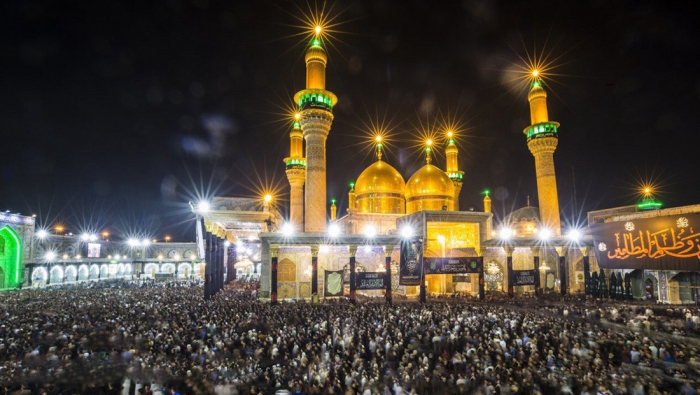
Friday, 25 Rajab, corresponding to January 16, 2026, marks the anniversary of the martyrdom of the seventh Imam of the Muslims, Imam Musa ibn Ja‘far (peace be upon him), and on the 26th of Rajab falls the anniversary of the passing of his grandfather Abu Talib (peace be upon him), the Protector, Supporter, and Uncle of the Prophet (peace be upon him and his holy progeny). On these sorrowful occasions, institutions and Islamic centers in Europe and elsewhere commemorate these memories, while millions of pilgrims from inside and outside Iraq head toward the sacred shrine in al-Kadhimiyyah, seeking the purified sanctuary of the Imam (peace be upon him) in order to hold mourning gatherings there.
Speaking of Imam Musa al-Kadhim (peace be upon him), as with the rest of the Imams of Ahlul Bayt (peace be upon them), is a discussion of supporting the religion and upholding values and noble ideals. They all devoted themselves entirely for the sake of Allah to protect Islam and support its cause. Yet what distinguishes the Imam’s life from that of his forefathers and descendants is that he lived through one of the most difficult eras of Islamic history—an era in which Abbasid rule transitioned from establishment to consolidation, accompanied by increasing suppression and harsh restrictions upon Ahlul Bayt (peace be upon them) and their followers. In this period, the Imam’s mission was to preserve the institution of Imamate and protect its prophetic role from disintegration or deviation, while continuing the duties of guidance and spiritual nurturing of his community—away from the spotlight and away from direct political confrontation.
However, what is truly painful regarding the life of Abu Talib (may Allah be pleased with him) is that Muslims and Islamic centers have not given him special attention as they do for the commemorations of the Imams of Ahlul Bayt (peace be upon them), despite the fact that this noble personality holds the greatest merit for Islam and the Muslims, due to his unmatched sacrifice and dedication in establishing Islam, promoting its message, and supporting the Prophet (peace be upon him). He would protect the Messenger of Allah (peace be upon him) even through the sacrifice of his own children, safeguarding the Prophet’s life. This spirit of sacrifice and courageous support continued through his pure descendants, who demonstrated their extraordinary loyalty and devotion in the tragedy of Karbala.
For this reason, the Prophet (peace be upon him) and the Ahlul Bayt (peace be upon them) greatly honored his struggle and his steadfast positions—positions rooted in his true faith in Islam and in the Prophethood of Muhammad (peace be upon him). Their narrations unanimously affirm his faith, and state that his light on the Day of Judgment will surpass every other light except that of the Chosen Prophet (peace be upon him), Ali al-Murtada (peace be upon him), Fatimah al-Zahra (peace be upon her), and the pure Imams (peace be upon them).
A number of prominent Sunni scholars shared this belief as well. Among this is what the great scholar Shaykh al-Amini mentioned in hi s book “Al-Ghadeer”, quoting a group of Sunni scholars who reached the same conclusion regarding Abu Talib’s faith and authored research and books in support of it. Among them were: al-Barzanji in Asna al-Matalib, al-Ajhuri, al-Iskafi, Abu al-Qasim al-Balkhi, Ibn Wahshi in his commentary on Shihab al-Akhyar, al-Tilimsani in Hashiyat al-Shifa’, al-Sha‘rani, Sibt Ibn al-Jawzi, al-Qurtubi, al-Subki, Abu Tahir al-Suyuti, and others. In fact, some of them—such as Ibn Wahshi, al-Ajhuri, and al-Tilimsani—ruled that whoever hates Abu Talib has disbelieved, and that whoever speaks of him with disrespect has also disbelieved—especially considering that his poetry overflows with the spirit of faith in Islam and loyalty to the Prophet (peace be upon him).
We also should not forget that Abu Talib left behind a rich collection of poetry in defense of Islam and the Messenger of Allah (peace be upon him), exceeding three thousand verses, which were preserved and compiled. Literary scholars and historians have stood in admiration and amazement, wondering: how could such poetry be spoken publicly in those circumstances, within the hearing of Quraysh, the polytheists, and their allies—while it clearly expresses support, defense, open struggle, bold faith, and unwavering sincerity?
Therefore, the infallible Imams (peace be upon them) recommended to their followers that they teach their children the poetry of Abu Talib, because it strengthens their faith and belief in Allah. Imam Ali (peace be upon him) loved the narration and documentation of Abu Talib’s poetry, and used to say: “Memorize it and teach it to your children, for he was upon the religion of Allah, and within it is great knowledge.” Imam al-Sajjad (peace be upon him) used to advise his companions similarly. Even the Prophet (peace be upon him) would rejoice when he heard Abu Talib’s poetry.
On the occasion of Abu Talib’s anniversary, we recall what al-Shablanji al-Shafi‘i mentioned in Nur al-Absar, quoting a report that when Imam Ali (peace be upon him) informed the Messenger of Allah (peace be upon him) of the death of his father, the Prophet wept and said: “Go, O Ali, and take charge of his affairs—wash him, perfume him, shroud him. When you lift him upon his bier, inform me.” Imam Ali did so, and when he raised him upon the bier, the Prophet (peace be upon him) met him with compassion and deep sorrow and addressed his uncle saying: “You upheld ties of kinship, and you shall be rewarded with goodness, O uncle. You raised and cared for me when I was young, and you supported and defended me when I grew.” Then he turned to the people and said:
“By Allah, I will intercede for my uncle with an intercession that will astonish the two weighty communities (humankind and jinn).”
We ask Allah, the Exalted, to grant Muslims success in reviving these religious occasions, for through their remembrance hearts are revived, and through them the sacred symbols of Allah are honored: “That is so. And whoever honors the symbols of Allah—indeed it is from the piety of hearts.”
Peace be upon the two noble and great figures, as long as the sun rises and sets.
×![]()